> ## Documentation Index
> Fetch the complete documentation index at: https://docs.asisso.com/llms.txt
> Use this file to discover all available pages before exploring further.
# Twilio Integration
> Configure Twilio for voice communication in Asisso
## Overview
Twilio is a cloud communications platform that enables voice calling, messaging, and video capabilities. Asisso's Twilio integration provides seamless connectivity for your voice agents.
## Prerequisites
Before setting up Twilio integration, you'll need:
* A [Twilio account](https://www.twilio.com/try-twilio)
* Account SID and Auth Token from your Twilio Console
* At least one Twilio phone number
* Asisso instance running and accessible
## Configuration
### Step 1: Get Twilio Credentials
1. Log in to your [Twilio Console](https://console.twilio.com/)
2. Find your **Account SID** and **Auth Token** on the dashboard
3. Navigate to **Phone Numbers** → **Manage** → **Active Numbers**
4. Copy your phone number(s)
### Step 2: Configure in Asisso
1. Navigate to **/telephony-configurations** and click **Add configuration**
2. Select **Twilio** as your provider
3. Enter your credentials:
* Account SID
* Auth Token
4. Click **Save Configuration**
5. Open the configuration you just created and add at least one **phone number** (with country code in E.164 format, e.g. `+1234567890`). The default caller ID is used for outbound calls.
### Step 3: Test Your Configuration
1. Create a test workflow
2. Click "Call" to verify connection
3. Check call logs for successful connection
## Inbound Calling Setup
Inbound routing is driven by the phone number itself — there is a **single webhook URL** for the entire org, and Asisso resolves which agent to run from the called number's assigned inbound workflow. **When you save an inbound workflow on a phone number, Asisso automatically pushes the webhook URL to that number's `VoiceUrl` in your Twilio account** (provided the credentials are correct and the number belongs to that account).
### Step 1: Assign an Inbound Workflow to the Phone Number
1. Go to **/telephony-configurations** and open your Twilio configuration
2. In the **Phone numbers** section, edit the number that should receive inbound calls
3. Set its **Inbound workflow** to the agent that should answer
4. Save
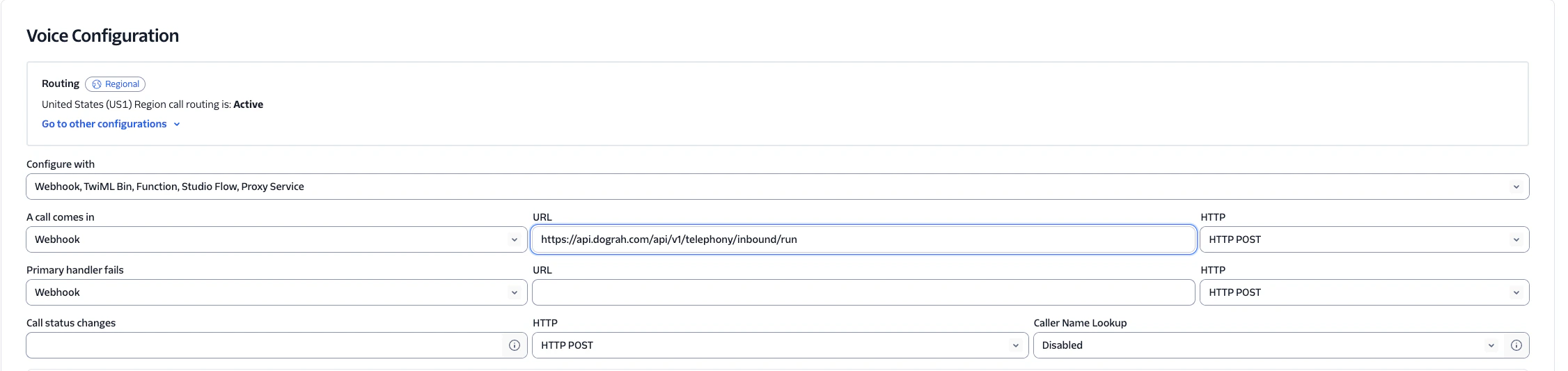
### Step 2: Verify the Webhook URL in Twilio Console
1. Go to **Phone Numbers** → **Manage** → **Active Numbers** in Twilio Console
2. Click the phone number you assigned an inbound workflow to in Step 1
3. In the **Voice Configuration** section, confirm:
* **Webhook** is set to: `https://api.asisso.com/api/v1/telephony/inbound/run`
* **HTTP Method** is `POST`
Asisso pushed this URL automatically when you saved the inbound workflow
in Step 1. If the field is empty, shows a different URL, or Asisso
surfaced a sync warning, the auto-push failed — most often because the
credentials are incorrect or the number isn't owned by this Twilio
account. Paste the URL into the field yourself, set the method to
`POST`, and click **Save Configuration**.
 ### Step 3: Verify Setup
* Ensure your Asisso instance is publicly accessible
* Verify any firewalls allow Twilio's IP ranges
### Test Inbound Calling
1. Call your configured Twilio phone number from another phone
2. Verify your Asisso voice agent answers and responds
3. Check call logs in both Asisso dashboard and Twilio Console
## Troubleshooting
Ensure phone numbers include country code in E.164 format: `+1234567890`
* Verify Account SID and Auth Token are correct - Check for extra spaces in
credentials - Ensure credentials haven't been regenerated in Twilio Console
* Confirm your Auth Token matches exactly - Verify the webhook URL matches
what Twilio sends - Check if you're behind a proxy that modifies requests
* Verify WebSocket connection is established - Check firewall rules for
WebSocket traffic - Ensure audio pipeline is configured correctly
* Verify the Twilio number's webhook is set to
`https://api.asisso.com/api/v1/telephony/inbound/run` - Ensure the webhook
URL is publicly accessible from the internet - Confirm the called number
exists in your Asisso telephony configuration and has an **Inbound
workflow** assigned - Verify Asisso instance is running and responding
* Confirm the phone number has an **Inbound workflow** assigned in
/telephony-configurations - Check webhook signature validation is working
(Auth Token in Asisso matches Twilio Console) - Verify WebSocket connection
establishes successfully - Review call logs for error messages
## Best Practices
* Test your configuration with a single call before running campaigns
* Monitor Twilio Console for usage and billing
### Step 3: Verify Setup
* Ensure your Asisso instance is publicly accessible
* Verify any firewalls allow Twilio's IP ranges
### Test Inbound Calling
1. Call your configured Twilio phone number from another phone
2. Verify your Asisso voice agent answers and responds
3. Check call logs in both Asisso dashboard and Twilio Console
## Troubleshooting
Ensure phone numbers include country code in E.164 format: `+1234567890`
* Verify Account SID and Auth Token are correct - Check for extra spaces in
credentials - Ensure credentials haven't been regenerated in Twilio Console
* Confirm your Auth Token matches exactly - Verify the webhook URL matches
what Twilio sends - Check if you're behind a proxy that modifies requests
* Verify WebSocket connection is established - Check firewall rules for
WebSocket traffic - Ensure audio pipeline is configured correctly
* Verify the Twilio number's webhook is set to
`https://api.asisso.com/api/v1/telephony/inbound/run` - Ensure the webhook
URL is publicly accessible from the internet - Confirm the called number
exists in your Asisso telephony configuration and has an **Inbound
workflow** assigned - Verify Asisso instance is running and responding
* Confirm the phone number has an **Inbound workflow** assigned in
/telephony-configurations - Check webhook signature validation is working
(Auth Token in Asisso matches Twilio Console) - Verify WebSocket connection
establishes successfully - Review call logs for error messages
## Best Practices
* Test your configuration with a single call before running campaigns
* Monitor Twilio Console for usage and billing