

The three context objects
initial_context
Data available to the agent before the call starts — the contact’s name, account details, appointment information, anything the agent should know upfront. It can be set from several places:- API trigger — pass it in the request body when calling
POST /public/agent/{uuid}orPOST /telephony/initiate-call - Campaign CSV — columns beyond
phone_numberautomatically becomeinitial_contextfields for each contact’s call - Dashboard — set default template context variables on the agent, used when no external context is provided
Template variables
Values frominitial_context are available in your agent’s prompt using {{double_brace}} syntax.
Fallback values
If a variable might be missing or empty, use a pipe (|) to provide a default value:
customer_name is not set, the agent will say “Hello there” instead of leaving a blank. The syntax is:
Default variables
Built-in variables for current time and weekday, available in any prompt without setting upinitial_context.
Replace
<TIMEZONE> with an IANA timezone name such as Asia/Kolkata, America/New_York, or Europe/London.
When you use a timezone suffix on either
current_time or current_weekday, the other variable without a suffix will automatically use the same timezone instead of UTC. For example, if your prompt contains both {{current_time_Asia/Kolkata}} and {{current_weekday}}, the weekday will also be resolved in Asia/Kolkata.Telephony variables
For telephony calls (inbound and outbound), Asisso automatically adds these variables toinitial_context:
For inbound calls,
caller_number is the customer’s number and called_number is your Asisso number. For outbound calls, it’s the reverse — caller_number is your Asisso number and called_number is the customer’s number.
gathered_context
Data the agent collects during the call. You configure what to extract in the agent node’s extraction settings — each variable has a name, type, and a prompt that tells the LLM what to look for.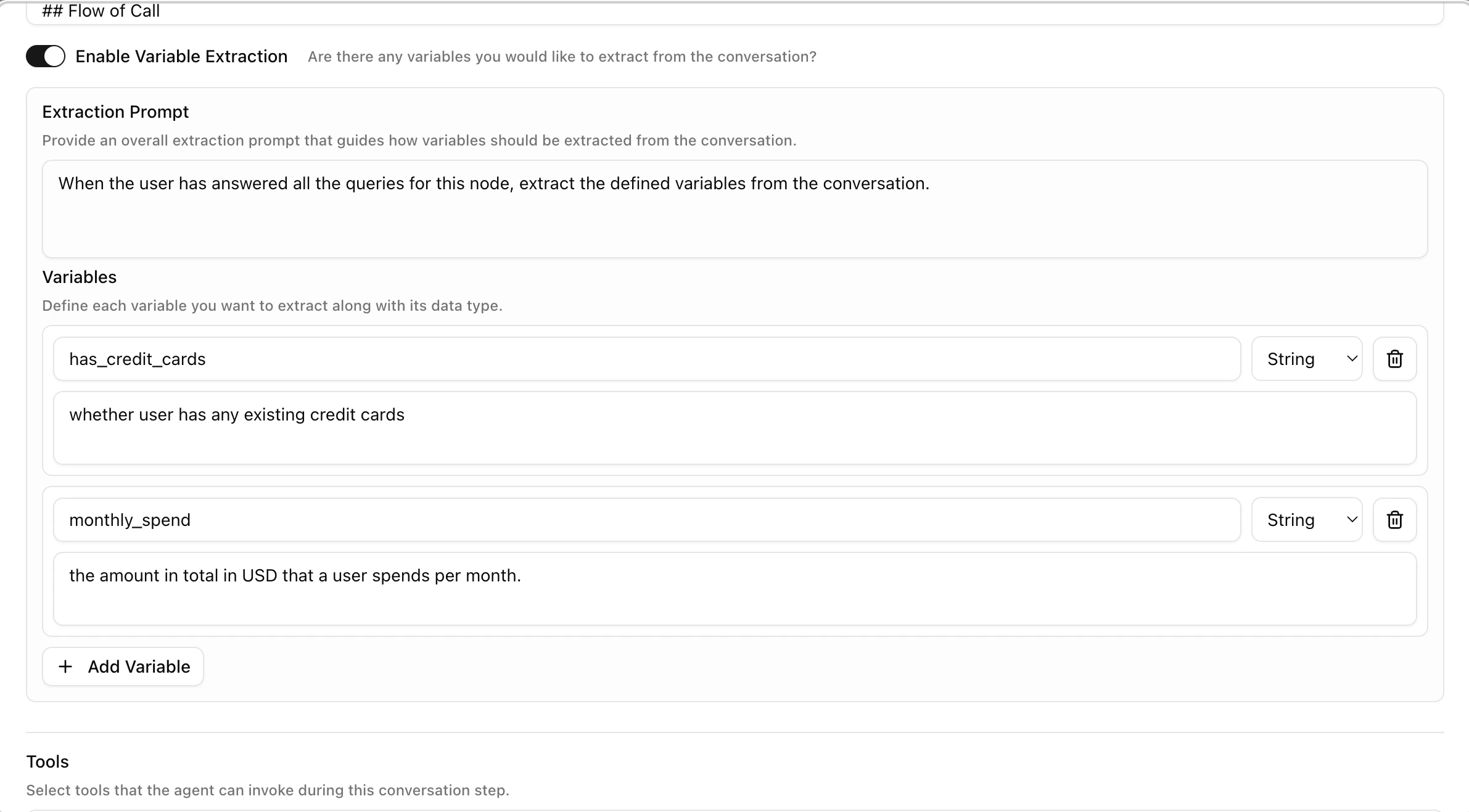
gathered_context is returned in the run record after the call completes and is available in webhook payloads for downstream processing.